By Anton Hart
My most memorable NIMBY experience occurred a few years ago. The fury of it all makes it seem like yesterday. I went to a meeting organized by members of my community who were aggrieved by the imminent arrival of a methadone clinic. The crowd literally spilled out onto the sidewalk of a local bar made available for the proceedings. Several doctors – clinic affiliates – were there, ostensibly to engage the community. After the chair and a local lawyer laid out the “facts,” the games began. For the next two hours or so not a rational thought surfaced, not a constructive word was spoken. The local representative on city counsel tried but was generally shouted down. The crowd went home in a highly excited mood to prepare their tar and feathers to ride the principals and politician out of town and so protect their neighbourhood. The raging battle spilled out into the kitchens, living rooms and local eateries. Even the local church found its voice a few days later when the Reverend Canon Christopher King, Senior Pastor of Little Trinity Church, wrote that “the church looks to Jesus as the one who shows us how to bring healing and transformation to hurting people and into communities. . . . He never compromised their safety by his healing, transforming work with social outcasts.” And so, the pastor reasoned, no clinic should come to his church’s back yard. Or, in this case, across the street.
On the other hand, the doctors at the meeting accused the crowd of not caring and putting their hard-earned home equity and personal welfare ahead of the dire needs of patients – who were also members of the community. The local blogger described it this way: “Tabarnouche! One would think, reading some of this, that the Gaping Gates of Hell were open and inhaling local residents in droves.”
Clearly, community engagement was not working.
This is not a new story. It is repeated often where we find the public fearful and frustrated when it has collectively determined that a cause, event or thing will destroy them. In this case, the clinic’s patients were presumed to be social outcasts who would threaten the neighbourhood and members of a church congregation. The mantra is, “build it anywhere – but not in my community.”
Let me report that this situation has since resolved itself to a dull roar, and postulate that it could now benefit from continued community engagement. These notes are a reflection of what subsequently happened and the application of some recent learnings. See what you think.
In the first place, neither the clinic nor the local politicians nor the government of the day engaged the community to ask them if and how and when they would like a methadone clinic in their community. They knew what the answer would be. Street smarts told them to stay under the radar. But the politicians also understood the need for the clinic in this community and even supported its owners in their search for a suitable building. Not fully succeeding in this limited goal they left the operators of the clinic, more or less, to their own devices. This, says journalist Malcolm Gladwell, is a process where the doing comes before engagement. And, I add, it is a demonstration that “doing” is more important to social change than any awareness campaign or pre-implementation community engagement. It is a demonstration that if you are in a position of power you can effectively begin the process of change. By doing. Consultation and awareness do not in themselves constitute change and, in fact, they accomplish nothing, says Gladwell. If anything, awareness (or community engagement) is the final stage of social change. That’s where it can have impact. Engagement is then designed specific to the goals set out. It is educational. But the doing will already have been done.
And so, in this community, the clinic went ahead. It weathered some unpleasant treatment from members of the community, a little extra attention from the media and from some vigilant cops keeping an eye on things. Today, the operators are keeping the place clean, enforcing rules to ensure a quiet operation and are going about their business without fanfare. As this was unfolding the Minister of Health (Ontario) commissioned a task force to take a close look at Methadone Maintenance Treatment across the whole province – prompted only in part by matters in his own riding. In response, the residents and business association – my neighbours – prepared and presented a thoughtful brief to the task force. Residents were given an opportunity to speak, and they gave heartfelt commentary. In the local blogger’s words, “Community residents presented their concerns in a dignified and reasonable way.” The advice was cogent, and the residents were heard. Some of the subsequent recommendations from the task force reflected the residents’ submission. In response, the provincial government set in place a province-wide program to improve communications, training, counselling, community engagement and other related services, and the city is working with the clinic to better integrate its operation with the neighbourhood. I know for a fact that the Minister made an unscheduled stop at the clinic – without fanfare.
The engagement shouldn’t stop here. It needs to be ongoing, and the mechanisms are available. Some members of the community stay in touch with the clinic owners, and the owners know where to find them. Some obvious exterior improvements have been slow to come about, hampered by city bureaucracy and some lethargy from the clinic’s operators. It’s a concern near the top of a neighbourhood’s list. Both the clinic and the city need to get on with it. (The same could be said for other businesses on the block.) The cops report little or no related crime and include the clinic in their rounds. In the meantime, new condominiums, new restaurants and new stores are all coming to the neighbourhood – unfazed by the operation of a methadone clinic with a stormy past. Real estate values are up. A few nay-sayers still want to be heard, but the neighbourhood’s silent optimists are drowning them out.
David Bornstein, who has studied social change and written about it, says that people who want to change the world are obsessively driven to succeed; they are, therefore, good listeners; they build good teams; they pay close attention to their environment; they stay focused on long-term goals but continually adapt to changing environments; and they are always looking for new opportunities to grow and innovate. By adopting this attitude, the local parliamentarian, the local councillor and the renewed rate payers’ group can improve this community, serve the sick and maybe even bring the church onside – or invite the Salvation Army to start a counselling service. The task force was strong on the need for counselling and community support. That presents an opportunity for continued community engagement.
In the end, I went back to the local blogger for a comment, and found that he had just posted a report that “research shows supportive housing has no effect on property values or crime rates. And, as in earlier studies, it showed initial community opposition disappeared once the homes opened.” Now’s the time, I add, for community engagement to ramp it up. Later is better.
Notes
Some of these thoughts come from the book, How to Change the World, by David Bornstein (Oxford University Press, 2004). They also reflect my notes taken during a debate between journalist Malcolm Gladwell and philosopher Mark Kingwell on the merits of awareness and engagement in the process of social change (May 13, 2008 on the campus of the University of Toronto).
Anton Hart is publisher of a range of healthcare publications from Longwoods Publishing Corporation, a member of a number of boards engaged in social change and the Chair of Ontario’s Methadone Maintenance Practices Task Force, which tabled its final report in March 2007. Contact: ahart@longwoods.com
Monday, May 26, 2008


Taking Community Engagement Seriously: How to Find Good Ideas and Make Them Stick
By Neil Seeman
IN THE LAST TWO YEARS, “community engagement” was mentioned more than 5,400 times in international newspapers and government and corporate press releases. Compare that to 1998-2000 when “community engagement” came up 111 times. What’s behind the new fashion in community engagement (a.k.a. “stakeholder engagement”), and does it work?
Community engagement (in my view) means developing and enhancing public participation in change: the more vigorously you engage stakeholders, the more you will understand their legitimate issues, misconceptions and potential resistance to change. Your solution will not only therefore be more effective, you will enjoy better “buy-in” for implementing new initiatives.
“Community engagement” is a concept that William E. Connolly, the Johns Hopkins political theorist, might consider an “essentially contested concept” : wide agreement exists on the virtues of the notion, but argument arises about what it means or what it aims to achieve. In some organizational contexts, extensive community engagement can reflect a culture of risk aversion (a.k.a. “buck-passing”) to the community; or political posturing (“hearing out the stakeholders,” with no follow-through). The exercise of consulting the community can be meaningless. Lacking intelligent oversight, the final result of expensive and time-consuming public engagement sessions is often a long list of complaints, unanswered questions, and unfulfilled wishes. The ensuing report makes it seem that everything (and, therefore, nothing) is a “priority”.
But sometimes – and let’s not kid ourselves, this is rarely done well – community engagement can bring about real, lasting innovation (though this “suitcase” word , too, needs definition). Why do some experiences in community engagement achieve greatness result while others remain an exercise in futility?
Before embarking on the engagement exercise, many fail to ask fundamental questions: Do community members offer better insights than those who have studied the issue; or are the “experts” themselves bound by conflicts (e.g., wanting research funds to evaluate new, untested programs rather than being keen on implementing proven solutions)? In some situations – e.g., improving access for the community – stakeholders offer profound insight and are in the ideal position to design solutions. When the solution needs to be adopted by the community to be effective (e.g., the use of walking trails or bike lanes to support increased physical activity), community engagement is critical. In other situations, community “stakeholders” come to the table with their stakes dug in. The concern may not be the bias itself, but leaving it undeclared.
To help illustrate the appropriate role for stakeholders, my IBM colleague, John Soloninka, has identified the following taxonomy of problems, and their related engagement goals :
Problem | Goal of Engagement
Complex problem needing expert solution
Engage stakeholders for input on what the problem is and possible solution elements, but do not ask them for the entire solution
Complex problem that only those on the front line know how to solve
Engage front line in designing the solution
Problem for which there is wide variation in opinion, and no “objectively” right solution (i.e., one based on values)
Engage in societal values definition
Problem for which there is poor general understanding of the facts among the general public, and many special interests legitimately or illegitimately driving misperception
Engage for education, and how to manage perceptions (this may be misinterpreted as paternalistic, and communications must therefore be managed delicately)
Once the right scope for community engagement is defined, there are two errors in logic that can trip up the initiative. These errors badly disrupt the progress of innovation.
First, it is a fallacy that all new ideas are of equal merit; secondly, more voices do not necessarily lead to better ideas. Ideas have to be sifted and weighed, and that takes serious effort.
The trouble with innovation in health care (or in any other sector) is that it’s not tangible; it cannot be measured easily – and its success cannot be easily predicted. When thinking about innovation, people often make an “attribution error,” welcoming an idea that is familiar because it fits well with traditional values of the culture or the organization. True novelty at first feels “foreign” and, therefore, is frequently rejected.
Gary Hamel of the London Business School finds this problem widespread among corporate executives today, and has compared the current state of business innovation unfavourably to the early 20th century era of Fredrick Winslow Taylor, who pioneered new ways of managing business, or to later 20th century examples such as the Toyota Production System or total quality management. In my view, this attribution error is exaggerated in healthcare, an expert-driven industry where there is a high degree of deference to yesterday’s opinion as the best model for tomorrow’s.
It is for these reasons that community engagement gatherings sometimes keep re-inviting the very same people who came to the previous session, usually the most outspoken and best mobilized groups, and measure the supposed success of the enterprise by the number, rather than the quality, of ideas generated.
Just as corporations generally tap into the creative potential of a very small proportion of their talent pool, health care leaders run the risk of enlisting only a small segment of their stakeholders when they try to generate innovative ideas. Insufficient resources are invested in marketing and recruitment efforts to get the right people to the table. More intelligence needs to be harvested to identify and quantify the good ideas – the ideas that have real promise of improving quality of life or another outcome of interest.
The problems of group idea-generation have been well-documented in the organizational context. Amy Edmondson of the Harvard Business School finds that corporate teaming exercises – often designed in good faith to be representative of a diversity of skill-sets and knowledge, typically break down in three ways. First, depending on who else is there, people may be too afraid to share information. Second, some people may be naïve about others’ self-interests, eliciting argument rather than generating ideas. Third, some people, all too aware of competing interests, withhold information. These problems can be overcome by an effective moderator and by group exercises such as role play where, for instance, the group is divided into fact-providers and Devil’s Advocates, and then roles are exchanged.
A greater challenge – especially in a tight funding environment – is inviting the right people (rather than just more people) to the sessions, and then synthesizing the best ideas.
Social networking tools online are instructive here. IBM, which launched its open “Innovation Jam” process in 2006 , posted White Papers and internal strategy documents online, inviting public comment using blogs. Customers, suppliers, and family members of employees provided input into IBM’s corporate strategy. Wired magazine has dubbed this approach “crowdsourcing.” The message here is to take risks and invite “competitors” and customers to the table; in the health care context, this might mean involving representatives from neighbouring hospitals, regions, private industry, and from government.
Once the ideas are generated, how are the best ones selected? Remember that idea generation and mobilization – the focus of any communication engagement – is just the first stage. In Crafting Organizational Innovation Processes, Kevin Desouza and colleagues dub the second stage “advocacy and screening”. They observe that corporations have more success when this process is transparent and standardized. The third stage is experimentation; this stage assesses the sustainability of ideas for a particular organization at a particular time. The fourth stage is commercialization or market testing – in a public health care context, this might mean “client feedback” – to analyze the costs and benefits of rolling out the innovation. Finally, the last stage is diffusion and implementation: gaining company-wide buy-in. In health care, this last stage means championing the idea internally and externally.
All this is to say that successful community engagement is more than just a cocktail party bringing together the usual suspects. It requires significant effort to find the right people – i.e., targeted message campaigns to historically unrepresented voices. It requires transparent analytics – such as statistical forecasting tools and correlation analyses to assess the anticipated impact of new ideas on outcomes of interest to corporate strategy. It then requires piloting; returning to the community to gain feedback on the ideas selected; and, finally, pursuing a corporate strategy in order to “own” the idea publicly.
Innovation is like a glow-worm, easier to see from far away, long after someone else has thought of it. If it weren’t hard, it wouldn’t be worth it.
-----------------
Neil Seeman, JD, MPH is a Managing Consultant and Researcher at IBM Healthcare and IBM Global Business Services in Toronto. He is a writer and adjunct professor of health services management at Ryerson University. His research focuses on governance and social networking tools in healthcare. He is currently writing a book about obesity and community. He may be reached at: neil@ca.ibm.com
IN THE LAST TWO YEARS, “community engagement” was mentioned more than 5,400 times in international newspapers and government and corporate press releases. Compare that to 1998-2000 when “community engagement” came up 111 times. What’s behind the new fashion in community engagement (a.k.a. “stakeholder engagement”), and does it work?
Community engagement (in my view) means developing and enhancing public participation in change: the more vigorously you engage stakeholders, the more you will understand their legitimate issues, misconceptions and potential resistance to change. Your solution will not only therefore be more effective, you will enjoy better “buy-in” for implementing new initiatives.
“Community engagement” is a concept that William E. Connolly, the Johns Hopkins political theorist, might consider an “essentially contested concept” : wide agreement exists on the virtues of the notion, but argument arises about what it means or what it aims to achieve. In some organizational contexts, extensive community engagement can reflect a culture of risk aversion (a.k.a. “buck-passing”) to the community; or political posturing (“hearing out the stakeholders,” with no follow-through). The exercise of consulting the community can be meaningless. Lacking intelligent oversight, the final result of expensive and time-consuming public engagement sessions is often a long list of complaints, unanswered questions, and unfulfilled wishes. The ensuing report makes it seem that everything (and, therefore, nothing) is a “priority”.
But sometimes – and let’s not kid ourselves, this is rarely done well – community engagement can bring about real, lasting innovation (though this “suitcase” word , too, needs definition). Why do some experiences in community engagement achieve greatness result while others remain an exercise in futility?
Before embarking on the engagement exercise, many fail to ask fundamental questions: Do community members offer better insights than those who have studied the issue; or are the “experts” themselves bound by conflicts (e.g., wanting research funds to evaluate new, untested programs rather than being keen on implementing proven solutions)? In some situations – e.g., improving access for the community – stakeholders offer profound insight and are in the ideal position to design solutions. When the solution needs to be adopted by the community to be effective (e.g., the use of walking trails or bike lanes to support increased physical activity), community engagement is critical. In other situations, community “stakeholders” come to the table with their stakes dug in. The concern may not be the bias itself, but leaving it undeclared.
To help illustrate the appropriate role for stakeholders, my IBM colleague, John Soloninka, has identified the following taxonomy of problems, and their related engagement goals :
Problem | Goal of Engagement
Complex problem needing expert solution
Engage stakeholders for input on what the problem is and possible solution elements, but do not ask them for the entire solution
Complex problem that only those on the front line know how to solve
Engage front line in designing the solution
Problem for which there is wide variation in opinion, and no “objectively” right solution (i.e., one based on values)
Engage in societal values definition
Problem for which there is poor general understanding of the facts among the general public, and many special interests legitimately or illegitimately driving misperception
Engage for education, and how to manage perceptions (this may be misinterpreted as paternalistic, and communications must therefore be managed delicately)
Once the right scope for community engagement is defined, there are two errors in logic that can trip up the initiative. These errors badly disrupt the progress of innovation.
First, it is a fallacy that all new ideas are of equal merit; secondly, more voices do not necessarily lead to better ideas. Ideas have to be sifted and weighed, and that takes serious effort.
The trouble with innovation in health care (or in any other sector) is that it’s not tangible; it cannot be measured easily – and its success cannot be easily predicted. When thinking about innovation, people often make an “attribution error,” welcoming an idea that is familiar because it fits well with traditional values of the culture or the organization. True novelty at first feels “foreign” and, therefore, is frequently rejected.
Gary Hamel of the London Business School finds this problem widespread among corporate executives today, and has compared the current state of business innovation unfavourably to the early 20th century era of Fredrick Winslow Taylor, who pioneered new ways of managing business, or to later 20th century examples such as the Toyota Production System or total quality management. In my view, this attribution error is exaggerated in healthcare, an expert-driven industry where there is a high degree of deference to yesterday’s opinion as the best model for tomorrow’s.
It is for these reasons that community engagement gatherings sometimes keep re-inviting the very same people who came to the previous session, usually the most outspoken and best mobilized groups, and measure the supposed success of the enterprise by the number, rather than the quality, of ideas generated.
Just as corporations generally tap into the creative potential of a very small proportion of their talent pool, health care leaders run the risk of enlisting only a small segment of their stakeholders when they try to generate innovative ideas. Insufficient resources are invested in marketing and recruitment efforts to get the right people to the table. More intelligence needs to be harvested to identify and quantify the good ideas – the ideas that have real promise of improving quality of life or another outcome of interest.
The problems of group idea-generation have been well-documented in the organizational context. Amy Edmondson of the Harvard Business School finds that corporate teaming exercises – often designed in good faith to be representative of a diversity of skill-sets and knowledge, typically break down in three ways. First, depending on who else is there, people may be too afraid to share information. Second, some people may be naïve about others’ self-interests, eliciting argument rather than generating ideas. Third, some people, all too aware of competing interests, withhold information. These problems can be overcome by an effective moderator and by group exercises such as role play where, for instance, the group is divided into fact-providers and Devil’s Advocates, and then roles are exchanged.
A greater challenge – especially in a tight funding environment – is inviting the right people (rather than just more people) to the sessions, and then synthesizing the best ideas.
Social networking tools online are instructive here. IBM, which launched its open “Innovation Jam” process in 2006 , posted White Papers and internal strategy documents online, inviting public comment using blogs. Customers, suppliers, and family members of employees provided input into IBM’s corporate strategy. Wired magazine has dubbed this approach “crowdsourcing.” The message here is to take risks and invite “competitors” and customers to the table; in the health care context, this might mean involving representatives from neighbouring hospitals, regions, private industry, and from government.
Once the ideas are generated, how are the best ones selected? Remember that idea generation and mobilization – the focus of any communication engagement – is just the first stage. In Crafting Organizational Innovation Processes, Kevin Desouza and colleagues dub the second stage “advocacy and screening”. They observe that corporations have more success when this process is transparent and standardized. The third stage is experimentation; this stage assesses the sustainability of ideas for a particular organization at a particular time. The fourth stage is commercialization or market testing – in a public health care context, this might mean “client feedback” – to analyze the costs and benefits of rolling out the innovation. Finally, the last stage is diffusion and implementation: gaining company-wide buy-in. In health care, this last stage means championing the idea internally and externally.
All this is to say that successful community engagement is more than just a cocktail party bringing together the usual suspects. It requires significant effort to find the right people – i.e., targeted message campaigns to historically unrepresented voices. It requires transparent analytics – such as statistical forecasting tools and correlation analyses to assess the anticipated impact of new ideas on outcomes of interest to corporate strategy. It then requires piloting; returning to the community to gain feedback on the ideas selected; and, finally, pursuing a corporate strategy in order to “own” the idea publicly.
Innovation is like a glow-worm, easier to see from far away, long after someone else has thought of it. If it weren’t hard, it wouldn’t be worth it.
-----------------
Neil Seeman, JD, MPH is a Managing Consultant and Researcher at IBM Healthcare and IBM Global Business Services in Toronto. He is a writer and adjunct professor of health services management at Ryerson University. His research focuses on governance and social networking tools in healthcare. He is currently writing a book about obesity and community. He may be reached at: neil@ca.ibm.com
Saturday, May 24, 2008
De-Regionalizing Alberta
The Road to Reform or Collateral Political Damage?
And then there was one.
by Steven Lewis
Last Wednesday (May 14, 2008), 12 boards governed Alberta’s 9 health regions, and the province’s mental health, cancer, and alcohol and addictions programs. A day later they were all replaced by the Alberta Health Services Board (AHSB). Alberta is the second province to eliminate RHA boards – PEI (population 140,000) was the first. New Brunswick is down to two. The Alberta solution is nothing if not Canadian: when in doubt, restructure.
Why this, and why now? Recent Alberta politics explain the timing. Premier Ed Stelmach was the surprise winner in the Conservative leadership race last year over heir apparent (and previous Calgary RHA Board Chair) Jim Dinning. Widely expected to suffer serious electoral losses in the recent election, Stelmach won a massive majority. This conferred a license to make a clear and dramatic statement as a means
of putting a new face on government and bidding a final adieu to the Klein-Calgary era.
The why is more interesting. Regionalization as originally conceived was intended to devolve authority from the provincial level while consolidating it at the local level. In no province was devolution as thoroughgoing as envisioned. Political accountability proved difficult to devolve, so governments continued to have to answer for alleged regional missteps. Over the years most provinces have repatriated authority from the regions, retaining control over major decisions such as facility closures and earmarking funds for specific purposes. But RHA boards do experiment and innovate, reach out across sectors, have mechanisms for responding to local concerns and preferences, and advocate for their regions.
So what, in the government’s view, is the trouble with regionalization? In April Health & Wellness Minister Ron Liepert said that a new governance model was needed to improve management. Perhaps the new regime sees the regions as vocal irritants always clamouring for money. Perhaps it was an accumulation of perceived sins, from the instrument sterilization cock-ups in East Central to the very public complaints of underfunding by the Calgary RHA leadership prior to and after the election. Structural reform does not guarantee improved access, better quality, or greater efficiency. Moreover, restructuring takes its toll on leadership and creates anxiety among the troops. It succeeds only when it is part of a coordinated, substantive plan to change the system’s culture, incentives, and accountability.
The creation of the AHSB is the first of a promised three stages of changes to be announced by December 15, 2008. The most concrete commitments thus far are to train more doctors, extend the ban on trans fats in restaurants and get rid of junk food in schools. Whatever the merits of these measures, they are hardly transformational, and none requires taking regionalization apart.
That leaves de-regionalization and its prospects for success. The key questions are:
• Will the promised Community Health Councils be acceptable substitutes for the RHA boards or dismissed as toothless imitations of the real deal? They are to be appointed by the AHSB, raising obvious questions about their independence and capacity to advocate and criticize. British Columbia had a two-tier system in the 1990s, with local community councils mandated to advise the RHA boards. The public had more connection to and confidence in the community councils than the RHA. The government eliminated the tension by getting rid of the community councils.
• What will become of the population health agenda? Reducing health disparities is intersectoral work that takes place at the neighbourhood and community level. One of the unsung triumphs of regionalization has been the education of boards about the non-medical determinants of health and the importance of addressing the root causes of ill health. Can a single provincial board even begin to understand and pursue a population health agenda in the face of the predictable preoccupation with access, wait times, drugs and technologies? Will the system stake its future on a highly
medicalized, technology-focused view of health? Who will champion prevention and health promotion, and back up rhetoric with dollars?
• How will the voices of the marginalized be heard? It’s daunting enough to get the attention of an RHA board, let alone a single provincial authority working out of Edmonton.
• If the model retains regions as administrative units, how much authority and flexibility will accrue to the executives? To what extent will they be able to reallocate funds and experiment with new approaches? Existing CEOs, several of whom have national and international reputations, have been given until April 2009 to find other work. Will this capacity find meaningful roles in the new era or will the province find itself with a severe executive talent shortage?
• The new board reports directly to the Minister. Will the Minister (and the ministry) set out a broad set of expectations and accountabilities and let the board operate with considerable autonomy – almost like a Crown Corporation – or will the leash be short? Will the power lie with the AHSB or with the Minister and Deputy?
All should clarify in the coming months. The first move shows no lack of courage: poking a stick in the eye of 125 politically well-connected board members and the communities they represent is a calculated act of disharmony. If there is leftover boldness to apply to the substantive issues, there are some intriguing possibilities. Imagine the AHSB with a mandate to achieve:
• A fully functional, interoperable, standardized electronic medical record within 2 years.
• A health human resources plan that optimizes the roles of all providers, with expanded roles for nurses, pharmacists, and therapists.
• The full integration of physicians into the system with a focus on primary health care.
• The removal of all of the perverse incentives in the system that drive up costs and stand in the way of equitable, high quality care.
• A brave, evidence-based, cost-effective approach to drug purchasing and prescribing.
• A real reduction in health disparities between the well-off and the disadvantaged.
In a jurisdiction truly committed to reform, the restructuring would be the warmup act to a genuine transformation agenda. Alberta’s health regions have arguably been leaders in quality improvement, health information technology adoption, and primary health care renewal. With the stroke of a pen a great deal of innovation capacity and experience has been cast aside. Nothing in the public communiqués to date suggests that anyone has thought very deeply about the risks and consequences of the dismantling. The challenge for the government and the AHSB is to get out of the gate with some creative policies and progressive decisions.
Without some early and tangible wins, the memory of May 15, 2008 may linger longer and deeper in the public consciousness than its architects ever imagined.
______________
Steven Lewis is President, Access Consulting Ltd., Saskatoon, Adjunct Professor of Health Policy, University of Calgary & Simon Fraser University and a member of the editorial advisory board for the journal Healthcare Papers | Steven.Lewis@shaw.ca
And then there was one.
by Steven Lewis
Last Wednesday (May 14, 2008), 12 boards governed Alberta’s 9 health regions, and the province’s mental health, cancer, and alcohol and addictions programs. A day later they were all replaced by the Alberta Health Services Board (AHSB). Alberta is the second province to eliminate RHA boards – PEI (population 140,000) was the first. New Brunswick is down to two. The Alberta solution is nothing if not Canadian: when in doubt, restructure.
Why this, and why now? Recent Alberta politics explain the timing. Premier Ed Stelmach was the surprise winner in the Conservative leadership race last year over heir apparent (and previous Calgary RHA Board Chair) Jim Dinning. Widely expected to suffer serious electoral losses in the recent election, Stelmach won a massive majority. This conferred a license to make a clear and dramatic statement as a means
of putting a new face on government and bidding a final adieu to the Klein-Calgary era.
The why is more interesting. Regionalization as originally conceived was intended to devolve authority from the provincial level while consolidating it at the local level. In no province was devolution as thoroughgoing as envisioned. Political accountability proved difficult to devolve, so governments continued to have to answer for alleged regional missteps. Over the years most provinces have repatriated authority from the regions, retaining control over major decisions such as facility closures and earmarking funds for specific purposes. But RHA boards do experiment and innovate, reach out across sectors, have mechanisms for responding to local concerns and preferences, and advocate for their regions.
So what, in the government’s view, is the trouble with regionalization? In April Health & Wellness Minister Ron Liepert said that a new governance model was needed to improve management. Perhaps the new regime sees the regions as vocal irritants always clamouring for money. Perhaps it was an accumulation of perceived sins, from the instrument sterilization cock-ups in East Central to the very public complaints of underfunding by the Calgary RHA leadership prior to and after the election. Structural reform does not guarantee improved access, better quality, or greater efficiency. Moreover, restructuring takes its toll on leadership and creates anxiety among the troops. It succeeds only when it is part of a coordinated, substantive plan to change the system’s culture, incentives, and accountability.
The creation of the AHSB is the first of a promised three stages of changes to be announced by December 15, 2008. The most concrete commitments thus far are to train more doctors, extend the ban on trans fats in restaurants and get rid of junk food in schools. Whatever the merits of these measures, they are hardly transformational, and none requires taking regionalization apart.
That leaves de-regionalization and its prospects for success. The key questions are:
• Will the promised Community Health Councils be acceptable substitutes for the RHA boards or dismissed as toothless imitations of the real deal? They are to be appointed by the AHSB, raising obvious questions about their independence and capacity to advocate and criticize. British Columbia had a two-tier system in the 1990s, with local community councils mandated to advise the RHA boards. The public had more connection to and confidence in the community councils than the RHA. The government eliminated the tension by getting rid of the community councils.
• What will become of the population health agenda? Reducing health disparities is intersectoral work that takes place at the neighbourhood and community level. One of the unsung triumphs of regionalization has been the education of boards about the non-medical determinants of health and the importance of addressing the root causes of ill health. Can a single provincial board even begin to understand and pursue a population health agenda in the face of the predictable preoccupation with access, wait times, drugs and technologies? Will the system stake its future on a highly
medicalized, technology-focused view of health? Who will champion prevention and health promotion, and back up rhetoric with dollars?
• How will the voices of the marginalized be heard? It’s daunting enough to get the attention of an RHA board, let alone a single provincial authority working out of Edmonton.
• If the model retains regions as administrative units, how much authority and flexibility will accrue to the executives? To what extent will they be able to reallocate funds and experiment with new approaches? Existing CEOs, several of whom have national and international reputations, have been given until April 2009 to find other work. Will this capacity find meaningful roles in the new era or will the province find itself with a severe executive talent shortage?
• The new board reports directly to the Minister. Will the Minister (and the ministry) set out a broad set of expectations and accountabilities and let the board operate with considerable autonomy – almost like a Crown Corporation – or will the leash be short? Will the power lie with the AHSB or with the Minister and Deputy?
All should clarify in the coming months. The first move shows no lack of courage: poking a stick in the eye of 125 politically well-connected board members and the communities they represent is a calculated act of disharmony. If there is leftover boldness to apply to the substantive issues, there are some intriguing possibilities. Imagine the AHSB with a mandate to achieve:
• A fully functional, interoperable, standardized electronic medical record within 2 years.
• A health human resources plan that optimizes the roles of all providers, with expanded roles for nurses, pharmacists, and therapists.
• The full integration of physicians into the system with a focus on primary health care.
• The removal of all of the perverse incentives in the system that drive up costs and stand in the way of equitable, high quality care.
• A brave, evidence-based, cost-effective approach to drug purchasing and prescribing.
• A real reduction in health disparities between the well-off and the disadvantaged.
In a jurisdiction truly committed to reform, the restructuring would be the warmup act to a genuine transformation agenda. Alberta’s health regions have arguably been leaders in quality improvement, health information technology adoption, and primary health care renewal. With the stroke of a pen a great deal of innovation capacity and experience has been cast aside. Nothing in the public communiqués to date suggests that anyone has thought very deeply about the risks and consequences of the dismantling. The challenge for the government and the AHSB is to get out of the gate with some creative policies and progressive decisions.
Without some early and tangible wins, the memory of May 15, 2008 may linger longer and deeper in the public consciousness than its architects ever imagined.
______________
Steven Lewis is President, Access Consulting Ltd., Saskatoon, Adjunct Professor of Health Policy, University of Calgary & Simon Fraser University and a member of the editorial advisory board for the journal Healthcare Papers | Steven.Lewis@shaw.ca
Monday, May 12, 2008
Electronic Med Records Are Worth the Privacy Risk
From the Wall Street Journal Blog of November 29, 2007, 9:06 am
Poll: Electronic Med Records Are Worth the Privacy Risk
Posted by Jacob Goldstein
On the subject of electronic medical records, regular folks appear to agree with the health-wonk elite.
Yes, electronic records make it tougher to keep patients’ records private, most people said in a new poll from the WSJ Online and Harris Interactive. But the risk is worth it, because the records can also decrease errors and reduce health costs, according to a majority of respondents.
Overall, 60% of 2,153 respondents said the benefits of electronic medical records outweigh the risks; 63% said electronic records can significantly decrease the frequency of medical errors, 55% said they can significantly reduce costs, and 51% said they make it more difficult to ensure patients’ privacy.
A couple other interesting findings: 76% of respondents are confident that the doctor always “has an accurate and complete picture” of their prior medical history (we suspect a survey of docs would yield a less confident response to this one). And only 1% of respondents said they use a personal health record stored on the Internet — demonstrating that there’s plenty of room for growth in the ambitious personal-health Microsoft and Google are working on.
Health Blog Question of the Day: Do the benefits of electronic medical records outweigh the privacy risk? If so, what can be done to get more doctors to go electronic?
Poll: Electronic Med Records Are Worth the Privacy Risk
Posted by Jacob Goldstein
On the subject of electronic medical records, regular folks appear to agree with the health-wonk elite.
Yes, electronic records make it tougher to keep patients’ records private, most people said in a new poll from the WSJ Online and Harris Interactive. But the risk is worth it, because the records can also decrease errors and reduce health costs, according to a majority of respondents.
Overall, 60% of 2,153 respondents said the benefits of electronic medical records outweigh the risks; 63% said electronic records can significantly decrease the frequency of medical errors, 55% said they can significantly reduce costs, and 51% said they make it more difficult to ensure patients’ privacy.
A couple other interesting findings: 76% of respondents are confident that the doctor always “has an accurate and complete picture” of their prior medical history (we suspect a survey of docs would yield a less confident response to this one). And only 1% of respondents said they use a personal health record stored on the Internet — demonstrating that there’s plenty of room for growth in the ambitious personal-health Microsoft and Google are working on.
Health Blog Question of the Day: Do the benefits of electronic medical records outweigh the privacy risk? If so, what can be done to get more doctors to go electronic?
Balanced hospital budgets approved by South West LHIN (Ontario)
LONDON, ON, May 1 /CNW/ -
The South West Local Health Integration Network (LHIN) Board of Directors reviewed and approved Hospital Service Accountability Agreements (H-SAAs) for 16 hospitals yesterday for the fiscal year 2008/09 and 2009/10.
The following hospitals submitted balanced budgets for 2008/09 and 2009/10:
• Alexandra Hospital (Ingersoll)
• Alexandra Marine & General Hospital (Goderich)
• Hanover District Hospital
• Huron Perth Healthcare Alliance: Clinton Public Hospital, Seaforth Community Hospital, St. Marys Memorial Hospital, Stratford General Hospital
• Listowel Wingham Hospitals Alliance: Listowel Hospital and Wingham Hospital
• London Health Sciences Centre
• Middlesex Hospital Alliance: Four Counties Health Services (Newbury)
• South Bruce Grey Health Centre
• South Huron Hospital Association (Exeter)
• St. Joseph's Health Care, London
• St. Thomas-Elgin General Hospital
• Woodstock Private Hospital
The Board extended the budget negotiation period for four hospitals:
• Grey Bruce Health Services
• Middlesex Hospital Alliance: Strathroy Middlesex General Hospital
• Tillsonburg District Memorial Hospital
• Woodstock General Hospital
The review of H-SAAs at yesterday's Board meeting marks another step in an evolving process that began last fall when hospitals submitted the first draft of their annual plans. The South West LHIN will now work with the 16 hospitals to implement their annual plans and introduce a process to further assist the four hospitals that have not yet balanced their budgets.
"The completion of 16 agreements is an important milestone for our LHIN and for the communities served by our hospitals," says Tony Woolgar, chief executive officer of the South West LHIN. "We are continuing to work closely with the four hospitals that have not yet balanced their budgets and we are confident that they will be able to do so.
"The process for hospital budget development and approval this year is quite different than in the past and our hospitals have risen to the challenge, recognizing that it provides a solid foundation for system planning and performance improvement as we move forward," adds Woolgar.
QUICK FACTS
The 2008-2010 Hospital Service Accountability Agreement (H-SAA) process marks the first hospital budget negotiation between Ontario's 14 LHINs and hospitals. Hospitals are required to balance their budgets under the Local Health System Integration Act, 2006. Signed by the boards of directors of both hospitals and their LHIN, H-SAAs hold hospitals accountable for operating within a balanced budget and maintaining agreed upon service levels.
Ontario's LHINs have an accountability agreement with the Ministry of Health and Long-Term Care. For information on the South West LHIN's Ministry-LHIN Accountability Agreement, visit the "Accountability" section under "About our LHIN" at www.southwestlhin.on.ca
The South West Local Health Integration Network (LHIN) is a crown agency responsible for planning, integrating and funding more than 150 health service providers, including hospitals, long-term care homes, mental health and addictions agencies, community support services, community health centres, and the South West CCAC. Established under the Local Health System Integration Act, 2006, as one of 14 LHINs across Ontario, the South West LHIN operates an annual health care budget of $1.8 billion. The South West LHIN covers an area from Lake Erie to the Bruce Peninsula and is home to almost one million people.
The South West Local Health Integration Network (LHIN) Board of Directors reviewed and approved Hospital Service Accountability Agreements (H-SAAs) for 16 hospitals yesterday for the fiscal year 2008/09 and 2009/10.
The following hospitals submitted balanced budgets for 2008/09 and 2009/10:
• Alexandra Hospital (Ingersoll)
• Alexandra Marine & General Hospital (Goderich)
• Hanover District Hospital
• Huron Perth Healthcare Alliance: Clinton Public Hospital, Seaforth Community Hospital, St. Marys Memorial Hospital, Stratford General Hospital
• Listowel Wingham Hospitals Alliance: Listowel Hospital and Wingham Hospital
• London Health Sciences Centre
• Middlesex Hospital Alliance: Four Counties Health Services (Newbury)
• South Bruce Grey Health Centre
• South Huron Hospital Association (Exeter)
• St. Joseph's Health Care, London
• St. Thomas-Elgin General Hospital
• Woodstock Private Hospital
The Board extended the budget negotiation period for four hospitals:
• Grey Bruce Health Services
• Middlesex Hospital Alliance: Strathroy Middlesex General Hospital
• Tillsonburg District Memorial Hospital
• Woodstock General Hospital
The review of H-SAAs at yesterday's Board meeting marks another step in an evolving process that began last fall when hospitals submitted the first draft of their annual plans. The South West LHIN will now work with the 16 hospitals to implement their annual plans and introduce a process to further assist the four hospitals that have not yet balanced their budgets.
"The completion of 16 agreements is an important milestone for our LHIN and for the communities served by our hospitals," says Tony Woolgar, chief executive officer of the South West LHIN. "We are continuing to work closely with the four hospitals that have not yet balanced their budgets and we are confident that they will be able to do so.
"The process for hospital budget development and approval this year is quite different than in the past and our hospitals have risen to the challenge, recognizing that it provides a solid foundation for system planning and performance improvement as we move forward," adds Woolgar.
QUICK FACTS
The 2008-2010 Hospital Service Accountability Agreement (H-SAA) process marks the first hospital budget negotiation between Ontario's 14 LHINs and hospitals. Hospitals are required to balance their budgets under the Local Health System Integration Act, 2006. Signed by the boards of directors of both hospitals and their LHIN, H-SAAs hold hospitals accountable for operating within a balanced budget and maintaining agreed upon service levels.
Ontario's LHINs have an accountability agreement with the Ministry of Health and Long-Term Care. For information on the South West LHIN's Ministry-LHIN Accountability Agreement, visit the "Accountability" section under "About our LHIN" at www.southwestlhin.on.ca
The South West Local Health Integration Network (LHIN) is a crown agency responsible for planning, integrating and funding more than 150 health service providers, including hospitals, long-term care homes, mental health and addictions agencies, community support services, community health centres, and the South West CCAC. Established under the Local Health System Integration Act, 2006, as one of 14 LHINs across Ontario, the South West LHIN operates an annual health care budget of $1.8 billion. The South West LHIN covers an area from Lake Erie to the Bruce Peninsula and is home to almost one million people.
No immediate cash for the Calgary Health Region says Premier Ed Stelmach
Stelmach was in
"It was in September of 2000 that then minister of Infrastructure Ed Stelmach phoned the Calgary Health Region and said the funds for the new children's hospital would be made available," said
"So we were very pleased today to be able to tour the premier and his wife around the children's hospital to see what that commitment's resulted in."
Stelmach told reporters that he isn't making any commitments until after Health Minister Ron Liepert finishes his review of the health-care system. He said it's not just
"There are unique issues in every regional health authority in the
"If you go to
Both Liepert and Stelmach have stressed that there must be changes to get a handle on spiralling costs that have hit $13 billion. That means the province is spending a third of its budget on health care, but there are still long wait times and shortages of doctors and nurses.
"We have to find a way to make is sustainable and everybody tells us that if you are going to be increasing your budgets year by year and eventually you double it," he said. "If you double it, which department do you take out?"
Stelmach has said such a financial burden will eventually hinder the government from moving on other priority areas such as education. He said there is a reason the Capital Health Regional in
Canadian Press
Saturday, May 3, 2008
Will Pan Canadian standards for our electronic health records leave Canadian snow birds out in the cold?
Industry leaders from Canada Health Infoway (Infoway), Canadian Healthcare Information Technology Trade Association (CHITTA, the Health Division of Information Technology Association of Canada (ITAC)), and the Association of Health Technology Industry (AITS) have formed a task force to accelerate and promote the transition to a new set of pan-Canadian health information technology standards – intended to accelerate electronic health records in Canada.
What?
The task force will collaboratively work to promote the adoption of pan-Canadian standards, especially with point of service systems, by engaging clinicians, health care providers and vendors. Involving these stakeholders will support the planning required to ensure the interoperable electronic health record (iEHR) is leveraged and the adoption of pan-Canadian standards is accelerated.
So . . . On the one hand: Infoway and partners have formed a task force with a mandate for a new set of pan-Canadian health information technology standards. But why just “pan-Canadian”? It sounds like future Snow Birds could be left out in the cold when they need care during their winter sojourns in warmer climates. They will be able to get their money but with their Canadian standards may not be able to get their blood type. (Is it A negative or O negative?)
On the other hand: Infoway acknowledges that Microsoft and Google will be offering (with considerable clout) personal health records to Canadian consumers. See Infoway has personal health record concerns from HealthEdition.com
Our inventive IT industries [most of them multi-nationals] will hopefully carry the day and ensure a global standard that also works for Canadians. Maybe a "Panstandard?"
Saturday, April 19, 2008
The Impact of the Electronic Health Record on Patient Safety: An Alberta Perspective
by Patrick Binns
Alberta is at the leading edge in developing its electronic health record (EHR), a provincial initiative to provide healthcare providers with immediate access to a patient's medication history and laboratory test results, regardless of where they are in the province, or where the patient's drugs or other treatments were ordered. The Alberta EHR was launched in October 2003. So far 6,000 healthcare providers have voluntarily signed on to use it, and benefits to patient safety have been reported. The EHR is an important part of healthcare renewal that is required to improve patient safety. Read the whole article by clicking here.
Alberta is at the leading edge in developing its electronic health record (EHR), a provincial initiative to provide healthcare providers with immediate access to a patient's medication history and laboratory test results, regardless of where they are in the province, or where the patient's drugs or other treatments were ordered. The Alberta EHR was launched in October 2003. So far 6,000 healthcare providers have voluntarily signed on to use it, and benefits to patient safety have been reported. The EHR is an important part of healthcare renewal that is required to improve patient safety. Read the whole article by clicking here.
Wal-Mart partners with hospitals to rapidly expand in-store clinics
Analysts say the giant retailer wants the good will a trusted hospital name can provide. Hospitals, meanwhile, say they don't intend to compete with physicians.
By Pamela Lewis Dolan, AMNews staff. Feb. 25, 2008.
As big-name national retailers and pharmacy chains continue to open in-store clinics, a familiar face soon may enter the fray as well -- your local hospital.
Wal-Mart recently announced plans to partner with community hospitals across the country to open up 400 new retail clinics inside its stores by 2010, in addition to the 55 it already houses. Thirteen of those are owned and operated by hospital systems.
The rebranded "Clinic at Wal-Mart" also will sport the name of the partnering health system providing the nurse practitioners and physician assistants dispensing care, as well as the doctors overseeing them. But Wal-Mart would standardize the clinics so they have a similar look and feel, such as having each clinic post a price list and keep similar hours.
To continue reading this report please click here.
Friday, April 18, 2008
A First Comparison of Google Health and MS HealthVault
[Posted (on his own blog) by Vince Kuraitis on March 2, 2008. Intro only. To see the complete entry click on the title above.]
While details are thin, here’s a first pass at comparing and contrasting Google Health (GH) and Microsoft HealthVault (HV). Overall, there are many common features, some differences, and many common challenges between these two platforms.
A High Level Comparison
Google Health and Microsoft HealthVault
Personal Health Information (PHI) Platforms
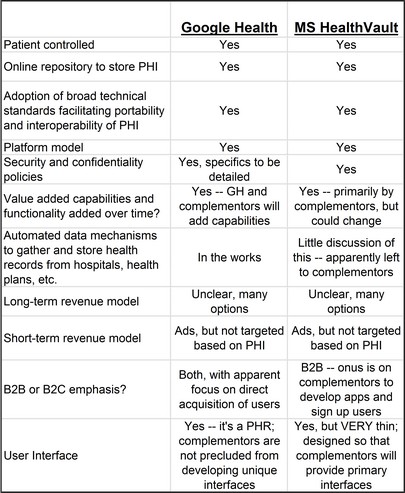
There’s still not much information available about the specifics of GH, although they did release sketchy information on the Official Google Blog . I’ll comment on a few of the particulars.
Commonalities
Both are patient controlled — data is released only with patient permission.
For more, click here.
Subscribe to:
Posts (Atom)
