by Patrick Binns
Alberta is at the leading edge in developing its electronic health record (EHR), a provincial initiative to provide healthcare providers with immediate access to a patient's medication history and laboratory test results, regardless of where they are in the province, or where the patient's drugs or other treatments were ordered. The Alberta EHR was launched in October 2003. So far 6,000 healthcare providers have voluntarily signed on to use it, and benefits to patient safety have been reported. The EHR is an important part of healthcare renewal that is required to improve patient safety. Read the whole article by clicking here.
Saturday, April 19, 2008


Wal-Mart partners with hospitals to rapidly expand in-store clinics
Analysts say the giant retailer wants the good will a trusted hospital name can provide. Hospitals, meanwhile, say they don't intend to compete with physicians.
By Pamela Lewis Dolan, AMNews staff. Feb. 25, 2008.
As big-name national retailers and pharmacy chains continue to open in-store clinics, a familiar face soon may enter the fray as well -- your local hospital.
Wal-Mart recently announced plans to partner with community hospitals across the country to open up 400 new retail clinics inside its stores by 2010, in addition to the 55 it already houses. Thirteen of those are owned and operated by hospital systems.
The rebranded "Clinic at Wal-Mart" also will sport the name of the partnering health system providing the nurse practitioners and physician assistants dispensing care, as well as the doctors overseeing them. But Wal-Mart would standardize the clinics so they have a similar look and feel, such as having each clinic post a price list and keep similar hours.
To continue reading this report please click here.
Friday, April 18, 2008
A First Comparison of Google Health and MS HealthVault
[Posted (on his own blog) by Vince Kuraitis on March 2, 2008. Intro only. To see the complete entry click on the title above.]
While details are thin, here’s a first pass at comparing and contrasting Google Health (GH) and Microsoft HealthVault (HV). Overall, there are many common features, some differences, and many common challenges between these two platforms.
A High Level Comparison
Google Health and Microsoft HealthVault
Personal Health Information (PHI) Platforms
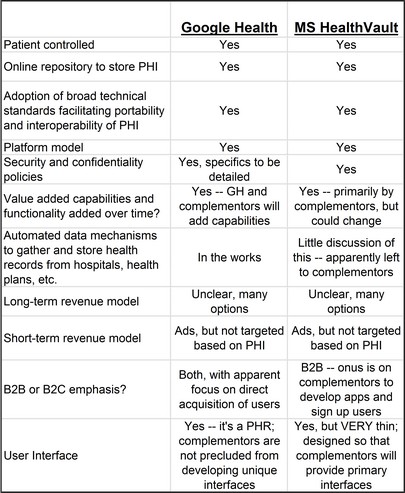
There’s still not much information available about the specifics of GH, although they did release sketchy information on the Official Google Blog . I’ll comment on a few of the particulars.
Commonalities
Both are patient controlled — data is released only with patient permission.
For more, click here.
Thursday, April 17, 2008
Google vs. Wal-Mart in Electronic Health Record Battle for Consumers
The most powerful consumer Internet company in the world and the world's most powerful consumer retailer seek to control consumer WEB access to the powerful health care industry.
Microsoft vs. Google for consumer health care dominance is the typical battle cry.
Nevertheless, in the fight to “consumerize” health care via technology, major U.S. employers are powerful stakeholders in their own rights, as they battle to control medical insurance costs for their workers on a daily basis.
How about Dr. Google vs. Dr. Wal-Mart? Click on the title and read on . . .
Canada Takes a Closer Look at Personal Health Records
Microsoft, Wal-Mart and Google have been actively developing this technology. In February, 2008, Google launched a pilot with a medical institution committed to giving patients access to their own medical records: The Cleveland Clinic. A large academic medical center, Cleveland is one of the first partners to integrate on the Google platform.
For more on the Google initiatives see:
Google Conversations about Health & Records
A pilot with the Cleveland Clinic for health information access
Warning on Storage of Health Records. The New York Times Comments on Article from The New England Journal of Medicine
by STEVE LOHR
For the full article click on the title of this blog entry.
In an article in The New England Journal of Medicine, two leading researchers warn that the entry of big companies like Microsoft and Google into the field of personal health records could drastically alter the practice of clinical research and raise new challenges to the privacy of patient records.
The authors, Dr. Kenneth D. Mandl and Dr. Isaac S. Kohane, are longtime proponents of the benefits of electronic patient records to improve care and help individuals make smarter health decisions.
But their concern, stated in the article published Wednesday and in an interview, is that the medical profession and policy makers have not begun to grapple with the implications of companies like Microsoft and Google becoming the hosts for vast stores of patient information.
The arrival of these new corporate entrants, the authors write, promises to bring “a seismic change” in the control and stewardship of patient information.
Today, most patient records remain within the health system — in doctors’ offices, hospitals, clinics, health maintenance organizations and pharmacy networks. Federal regulations govern how personal information can be shared among health institutions and insurers, and the rules restrict how such information can be mined for medical research. One requirement is that researchers have no access to individual patients’ identities.
For the full article click on the title of this blog entry.
Google Conversations about Health & Records
A pilot with the Cleveland Clinic for health information access
2/21/2008 07:46:00 AM
I suffer from poor eyesight and intense seasonal allergies, but I'm thankful that health issues occupy just a small portion of my life. Even though I'm rather healthy, I sometimes find myself needing access to accurate health information. I can get a long way by searching for health facts online, but I also need to incorporate what I find with my own history of conditions and treatments. I didn't even realize I had allergies until my early twenties -- for more years than I care to admit, I'd forget that the "cold" I came down with in April was suspiciously similar to the one I had at exactly the same time the year before. I've often been overwhelmed when trying to determine or track a condition, because my personal record of health information is either nonexistent, or it's spread on forms and receipts from (at least) a dozen doctors and five insurance companies.
Working as an engineer here on the health team, I've been excited to participate in building tools that will help me and others manage our personal health information more effectively. Many innovators in the healthcare industry have worked hard to make results of doctor visits, prescriptions, tests and procedures available digitally. By using the GData protocol already offered in many Google products, and supporting standards-based medical information formats like the Continuity of Care Record (CCR), our health efforts will help you access, store and communicate your health information. Above all, health data will remain yours -- private and confidential. Only you have control over when to share it with family members and health providers.
This week, we hit another important milestone. We launched a pilot with a medical institution committed to giving patients access to their own medical records: The Cleveland Clinic. A large academic medical center, Cleveland is one of the first partners to integrate on our platform. Because of their size and reach with patients who already have access to their medical records online, Cleveland has been a great partner for us to test out our data sharing model. Patients participating in the Cleveland pilot give authorization via our AuthSub interface to have their electronic medical records safely and securely imported into a Google account. It's great to see our product getting into the hands of end users, and I look forward to the feedback that the Cleveland patients will provide us.
Cleveland is just the first of many healthcare providers that will securely send medical records and information via Google APIs at your request. We've been hard at work collaborating with a number of insurance plans, medical groups, pharmacies and hospitals. While this pilot is open initially to just a few thousand patients, I see it as an important first step to show how Google can help users get access to their medical records and take charge of their health information.

Links to this post
Thursday, April 10, 2008
Getting to Maybe
Getting to Maybe promises to make us effective agents of change by telling us how to improve the world by applying the science and process of social innovation.
The book begins with a brief story about Bob Geldof's historic response to the famine in Ethiopia. Here is a little-known musician who created a highly successful global initiative - the Live Aid Telethon - to raise awareness and money. This venture was about the power of one.
The book begins with a brief story about Bob Geldof's historic response to the famine in Ethiopia. Here is a little-known musician who created a highly successful global initiative - the Live Aid Telethon - to raise awareness and money. This venture was about the power of one.
The authors then describe a movement of multiple interactions that took Brazil from a very high infection rate for HIV/AIDS to a very low rate. No one leader could be identified.
Getting to Maybe analyzes how such changes happen and tries to answer the question, "How can the impossible become possible?" But the title of the book gives the authors away: there isn't an answer. The authors say that "there is no road map for social innovation; it is not a route that can be mapped step by step." Darned. Yet, the book talks about vision, a sense of calling, developing possibilities and the need for intense interactions, networking and information exchange. These factors, mixed with talent and skill in identifying and removing barriers, the authors say, will get you to "maybe."
I am not so sure. For example, by reading about the post-World War II Dutch emigration movement, I was shown a direct path of social innovation that was repeated family after family and year after year. The book To All My Children, by Albert Van der Mey (Paideia Press), demonstrates emigrants' motivations, their often uninhabitable beginnings, their resolve to build a better life, their commitment to community and social fabric and their passion and resolve. These qualities were the foundation of their economic and social success that evolved not many years later. There was a clear path, one often repeated by subsequent waves of immigrants. There was no maybe.
The authors get to "maybe" because that, it appears, is what they set out to do. If they had developed these themes and taken some risks, they might have presented a road map, a strategy and perhaps even a blueprint.
Yet, the many stories about social entrepreneurs are worth reading and serve to inspire those who have the vision. If anything, the reader will understand the importance of identifying roadblocks and reframing these as opportunities. This approach, of course, is not unique to social innovation.
The book is worthwhile, if only to read and re-read a short section on the objective of introducing patient-centred care. It quotes Dr. Don Berwick - CEO of the Institute of Healthcare Improvement and a Harvard professor - describing the treatment of a patient who, he says, is no fool and has a lot to contribute to his own care - if the system would let him. Find out how the patient is patronized, kept in the dark, fed strange foods and pretty much ignored as his care providers do everything to him and never with him. This situation is a problem that can be restated as an opportunity, and so become the impetus to design much-improved patient-centred care, with or without IT.
And if you do not know the story of Linda Lundström (and others like her), read the book. Ms. Lundström designs and makes women's clothing. She grew up in a community that included many First Nation families. When as a youngster she was faced by the reality of racism, she was moved to act. She returned to her hometown and applied her knowledge, skill and drive to engage the women and children, to offer hope and opportunity. This is the beginning of social transformation. As I write this, Ms. Lundström is facing her own challenges in dealing with the globalization of the fashion industry. In some form, she will re-emerge; just read the back of every price tag attached to her products: "I have a strong belief in the power of positive energy that all women are capable of radiating towards those we know, each other and the rest of the world."
It is the stories in this book that work. The social entrepreneurs profiled provide the learning and the motivation. They are inspiring.
A post-note: How to change the world
If you are interested in social entrepreneurs, find a copy of How to Change the World: Social Entrepreneurs and the Power of New Ideas, by David Bornstein (Oxford 2004). The author is a compelling writer who has travelled around the globe to give readers a glimpse of individuals and movements that have changed the world. The stories he has selected are captivating. For example, he describes how Florence Nightingale was motivated by inexplicable obsession, action and orientation for growth with an unwavering belief in the rightness of her ideas - and so she was well suited to apply concentrated focus, practical creativity and long-term energy to advance system change.Bornstein also writes about child protection in India, assisted living in Hungary, reforming healthcare in Brazil, care of AIDS patients in South Africa, micro credit and the Grameen Bank and the Child Survival Revolution attributed to James Grant, who headed UNICEF from 1980 to 1995.
At the end, Bornstein lists six qualities of successful social entrepreneurs, a blueprint that does not explain why people become social entrepreneurs but does make identifying them possible. And look, he says, at Changemakers.net, an initiative of Ashoka: Innovators for the Public, which focuses on the rapidly growing world of social innovation. It provides solutions and resources needed to help everyone become a "changemaker" and presents compelling stories that explore the fundamental principles of successful social innovation around the world.
Monday, April 7, 2008
Heart transplant patient survives thanks to tiny temporary pump
Montreal – April 4, 2008 Heart specialists at the McGill University Health Centre are the first in the world to implant a minimally-invasive cardiac support system called the Impella 5.0 into a patient who was suffering from acute rejection after a heart transplant. The procedure was performed in the heart catheterization lab by Dr. Renzo Cecere, Director of the MUHC Mechanical Heart Program, and Dr. Jean Phillipe Pelletier, an MUHC Interventional Cardiologist, on February 19.
"In the worldwide experience of about 300 implants of the Impella 5.0, this is the first case of its use in a heart transplant patient suffering from severe acute rejection,” states Dr. Cecere. “This device allowed us to stabilize the patient's condition until she responded to the powerful anti-rejection medications. Without this new technology, this patient would likely not have survived."
Already available in the US and Europe, the Impella 5.0 is most often used as a bridge to a moreHide all permanent therapy, allowing doctors more time to develop a definitive treatment strategy. It is designed to help restore cardiac stability in patients who develop heart failure after heart surgery and who have not responded to standard medical therapy. In this case however, the device was implanted in transplant patient where the main purpose was to take the pressure off the patient’s heart in order to allow it time to heal from the trauma of an acute rejection.
The Impella 5.0 is made up of a miniature pump which is mounted in a catheter and inserted through a small incision in the patient’s groin area. The catheter is advanced from the groin to the left ventricle of the heart, where it can stay for up to ten days.
"The Impella system is the most recent acquisition of the MUHC Mechanical Heart Program, and further expands our ability to offer state-of-the-art treatments to patients with advanced heart disease," says Dr. Cecere. Health Canada accepted the technology for use in this country in June, 2007.
About the McGill University Health Centre (MUHC)
The McGill University Health Centre (MUHC) is a comprehensive academic health institution with an international reputation for excellence in clinical programs, research and teaching. The MUHC is a merger of five teaching hospitals affiliated with the Faculty of Medicine at McGill University––the Montreal Children’s, Montreal General, Royal Victoria, and Montreal Neurological Institute and Hospital, as well as the Montreal Chest Institute. Building on the tradition of medical leadership of the founding hospitals, the goal of the MUHC is to provide patient care based on the most advanced knowledge in the health care field, and to contribute to the development of new knowledge.
Subscribe to:
Posts (Atom)
